
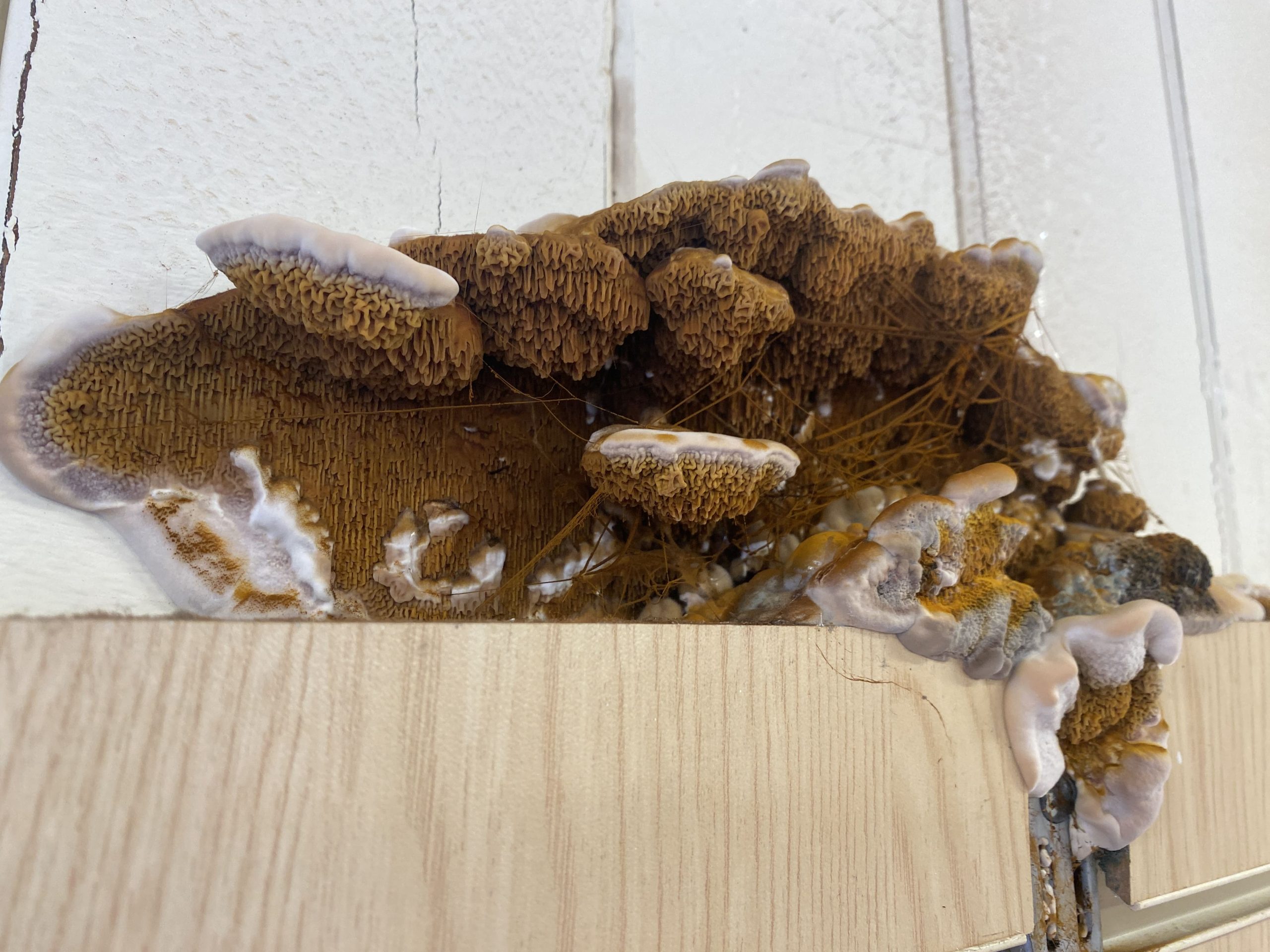
Fun Fact: Despite the name, dry rot isn’t actually dry…so what is it?
Dry rot is a type of fungal decay that attacks timber when there’s moisture and poor ventilation. The fungus most often responsible in buildings is Serpula lacrymans. Dry rot can spread through wood and even travel across masonry to reach new timber. If ignored, it can seriously weaken floors, skirting boards, door frames, roof timbers, and structural beams.
Unlike wet rot (which generally develops in timbers with a moisture content of 30-60%) dry rot forms within much lower and narrower moisture content levels of between 20-30%.
While dry rot spores are often in the air most of time, they require ideal conditions to be able to settle on timbers (their food source) and grow, namely wet and unventilated atmospheres.
A Practical Example in Alford
In December 2025, I observed first-hand the full life cycle of dry rot:
- Hyphae – the germination of the spores forms white cobweb type strands (seen behind the timber wall panelling).
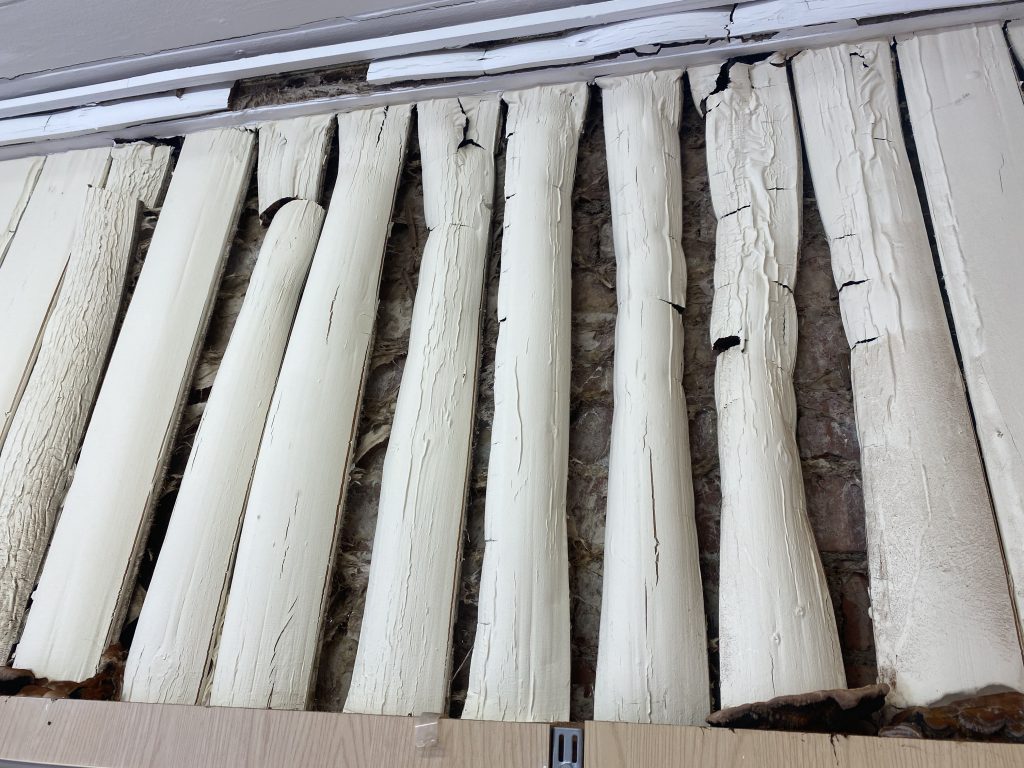
- Mycelium – hyphae develop to form white, cotton wool like structures which ‘send out’ strands in search of nutrients and moisture.
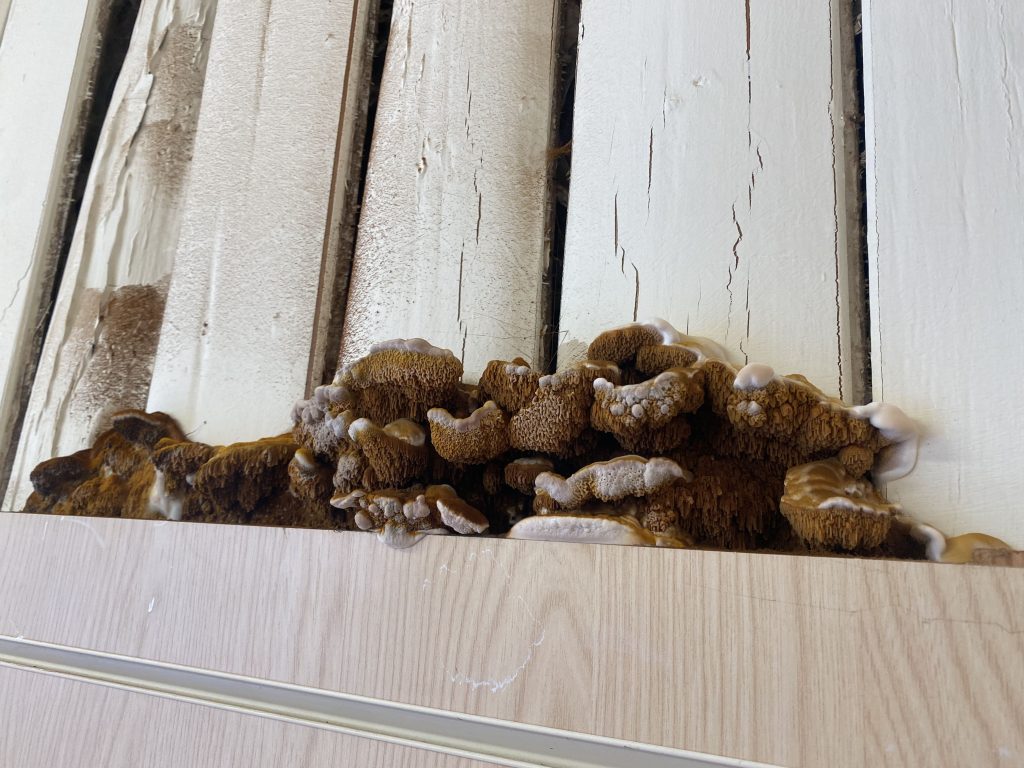
- Fruiting Bodies – when mycelium matures, or when conditions become adverse (e.g., food/moisture shortage), it triggers the growth of a fruiting body and the release of spores to reproduce. Generally thick, pancake-shaped structures with a, rusty-red/orange centre, and white, cotton-wool-like edges.
- Spores – produced by the fruiting bodies to reproduce. When in large, concentrated quantities, they look like a distinct, brick-red, or orange-brown dust (as seen on the top surface of the floorboards to the first floor).
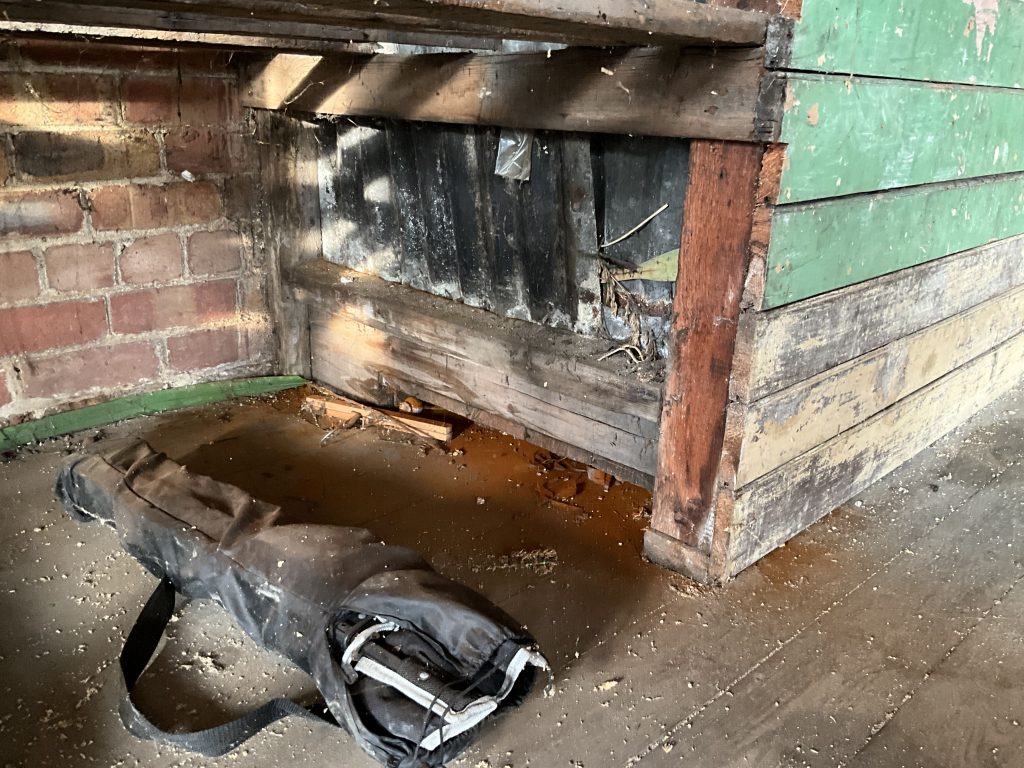
Surveying isn’t ever just a visual assessment 👀, using other senses such as feel to check for springy or sagging floors underfoot that may be affected 🚶🏼♂️➡️, as well as using smell to detect the distinctive damp, musty, mushroom-like smell of dry rot 👃🏼 (the latter being more critical in properties with less obvious infestations than this one!).
So why the name ‘dry’ rot if it needs moist conditions?
Wood affected by dry rot becomes darkened, brittle, or crumbly and shrinks and cracks into cube-like blocks (called cuboidal cracking). The damaged wood often feels dry and lightweight when found.
Dry rot will not extend into dry timber and so the primary remediation step is to improve environmental conditions by eliminating the source of moisture and increasing ventilation. In this case there was a leaking internal downpipe that needed to be exposed, inspected, and repaired.
Once the source of moisture has been dealt with, affected timbers should be removed & replaced and all fruiting bodies & visible spores removed (cleaning down all surfaces). Precautionary dry rot/fungicidal treatments can be applied to retained masonry (and retained adjacent timbers) to limit the risk of re-infestations but ultimately…